Does a model that knows more necessarily become more reliable on every scientific problem? And can a smaller model transfer its specialized strengths to a larger one?
Scientific reasoning failures often hide in individual steps. A model may write down the right equation but explain the mechanism incorrectly; it may solve an intermediate step yet fail at the final evidence judgment. ScienceRSI uses these local differences as opportunities for models to learn from one another.
Developed by Scinetics with researchers from Fudan University, the University of Science and Technology of China, and the Hong Kong University of Science and Technology, the framework organizes scientific model training around specialization, verification, transfer, and reuse.
01 Scientific capabilities need to accumulate across models
Training one model that excels at calculation and another that excels at mechanistic analysis does not automatically produce a more capable scientific assistant. Their strengths may be complementary, but their errors may also be carried together.
ScienceRSI asks a more precise question: for a specific failure of the current model, which expert can actually provide a better judgment? A contribution is accepted only when the expert outperforms the current answer on the same scientific criterion.
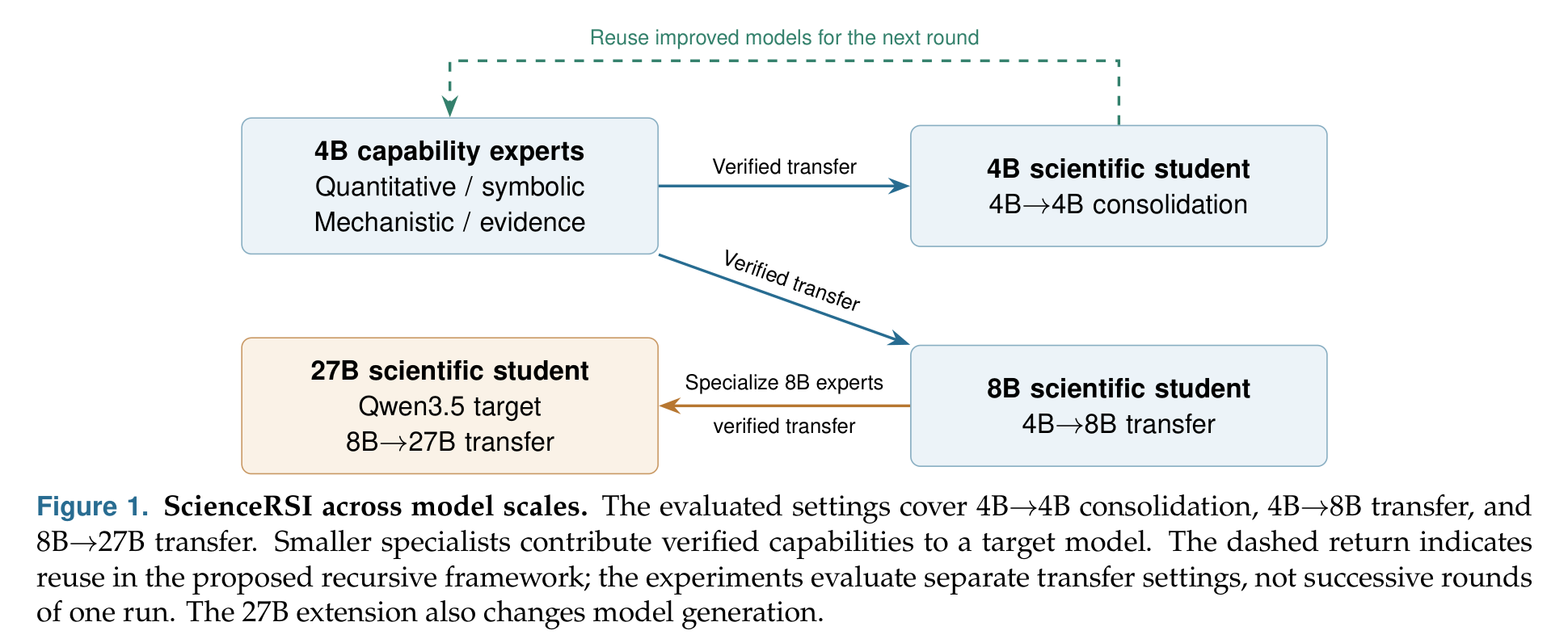
Specialize. Train compact experts with different strengths in quantitative calculation, symbolic derivation, mechanistic explanation, and evidence judgment.
Verify. Decompose answers into checkable requirements and test whether an expert is genuinely better on each requirement.
Transfer. Apply screened expert feedback to the specific parts of the target model that need improvement.
Reuse. Use the improved model as the starting point for further specialization and future cycles.
02 The 4B and 8B models lead across five scientific evaluations
The report evaluates seven benchmarks spanning scientific reasoning, domain science, and general reasoning. In both the 4B and 8B settings, ScienceRSI ranks first among the compared methods on all five scientific benchmarks.
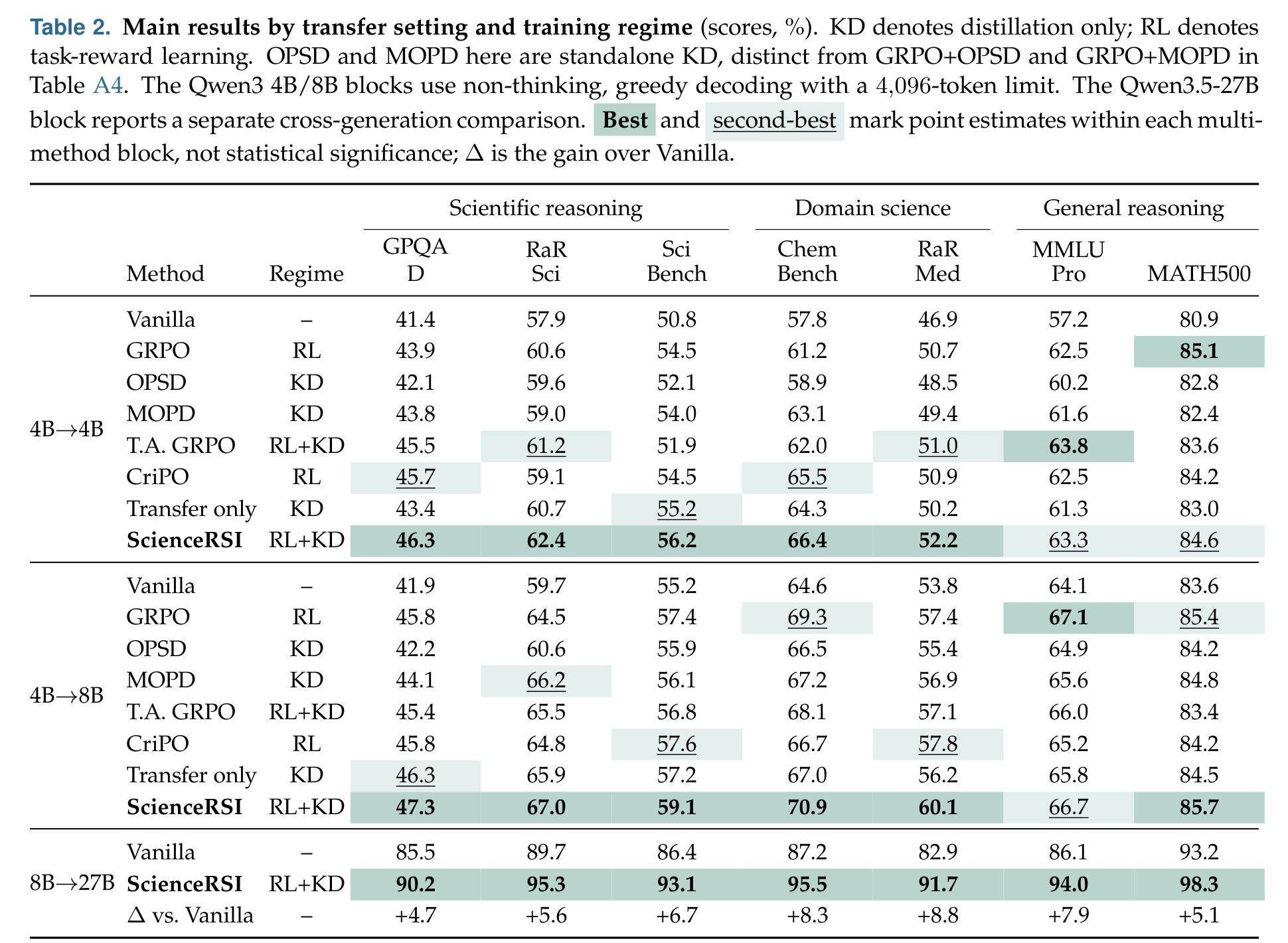
In 4B→4B consolidation, the average scientific-reasoning score reaches 55.0%, two percentage points above GRPO. In 4B→8B transfer, scientific-reasoning and domain-science averages improve by 1.9 and 2.1 points over GRPO, while the model reaches 85.7% on MATH500.
03 Smaller experts can improve a stronger 27B starting model
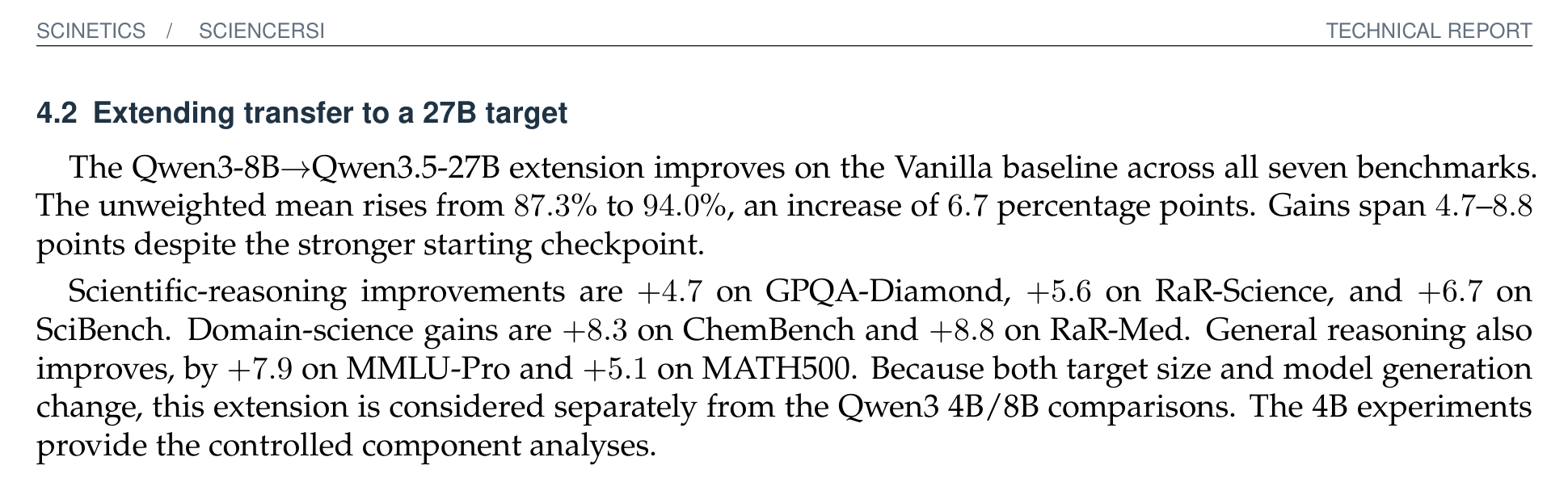
Using Qwen3-8B experts with a Qwen3.5-27B target, ScienceRSI improves all seven reported benchmark scores over the corresponding Vanilla starting model. The equally weighted average rises from 87.3% to 94.0%, with individual gains from 4.7 to 8.8 points.
04 Expert feedback must be filtered before it becomes useful
Simply exposing a student to dense expert supervision does not guarantee improvement. On the same 4B student, GRPO scores 53.0% on average scientific reasoning, GRPO+MOPD scores 50.1%, and ScienceRSI reaches 55.0%.
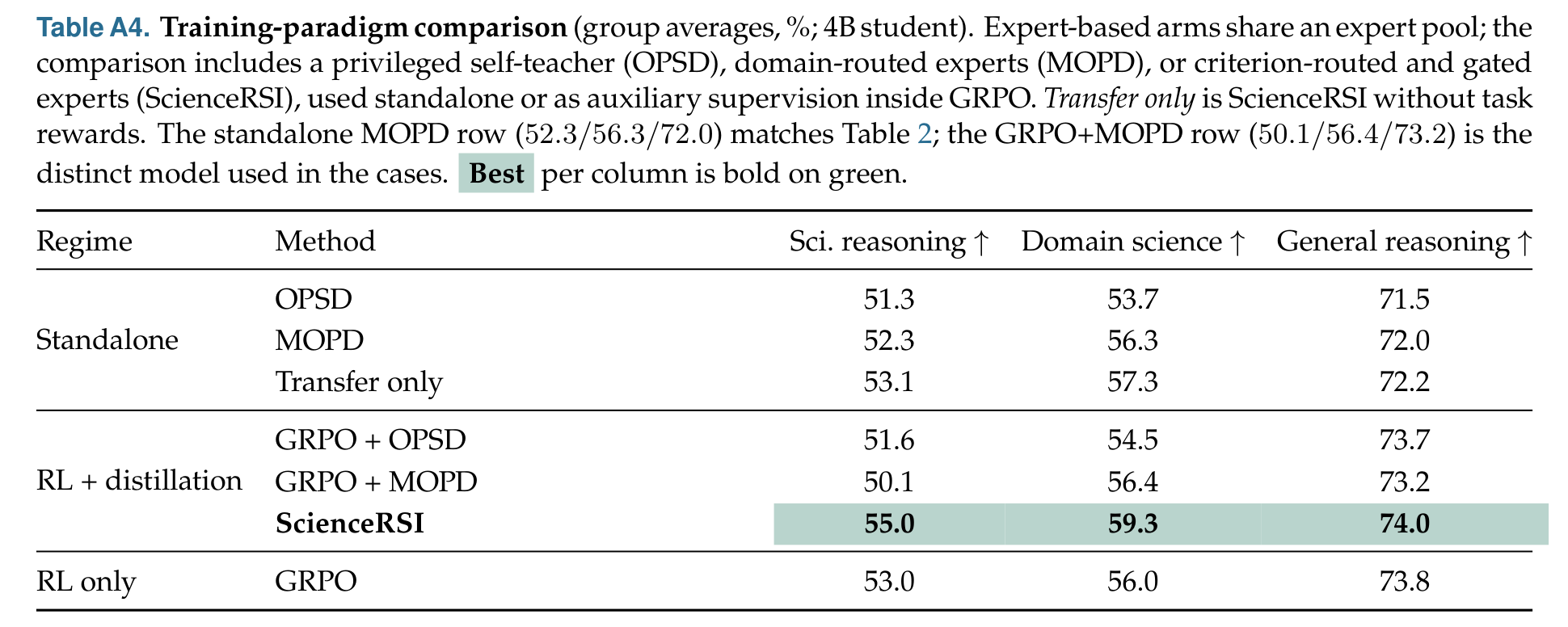
Removing contribution verification lowers the scientific-reasoning average from 55.0% to 50.6%. Randomly relocating the same amount of feedback reduces scientific-reasoning and domain-science averages by 6.3 and 12.1 points. The usefulness of a training signal depends on whether it corresponds to a real capability gap.
05 Toward recursive scientific self-improvement
This report validates capability transfer across model scales. It does not yet demonstrate that repeated recursive cycles will continue accumulating gains. As target models improve, specialization, task difficulty, and verification must evolve together to keep producing new learning value.
ScienceRSI provides an experimentally tested starting point: scientific capabilities can be specialized, verified, transferred, and reused instead of remaining isolated in individual models.
RESEARCH & MODEL