Large language models develop chains of thought in words. Scientists, however, often think in a different kind of “language”: moving an atom, comparing two protein conformations, or judging the plausibility of a hypothesis from an experimental curve.
This is the idea behind our proposed Chain of Science Tokens. It brings language and scientific objects into the same reasoning process: language specifies the goal, structures and data carry intermediate steps, and the scientific state produced at each step informs the next decision.
We are the Scinetics team, exploring foundation models and scientific agents for AI for Science. In our Perspective, “Scientific Super Intelligence: From Science Tokens to ScienceRSI” ↗, we organize this research direction around four interconnected questions.
The roadmap begins with Science Tokens, which make scientific objects readable and writable units of reasoning. It sets Scientific Super Intelligence as a capability goal, then uses ScienceRSI to turn task experience supported by evidence into training material for the next generation of models. Validated outcomes, in turn, become scientific assets that models and laboratories can reuse over time.
We first unpack this roadmap, then return to a concrete starting point: how our recent Chain of Structures work brings scientific spatial reasoning into enzyme design.
01 Bringing scientific objects into the reasoning process
For models, tokens are the basic units of information processing. Science Tokens extend this interface to scientific objects: protein and nucleic acid sequences, local three-dimensional geometry, microscopy images, omics states, and measurements with units and experimental conditions. Each can be represented in a way that suits its characteristics and can interact with language within the same model.
The key is to preserve scientific meaning. A number needs a unit; a measurement needs its conditions; and a structure needs to indicate whether it was predicted or experimentally determined. Different modalities can also retain different representations: sequences can use their native discrete symbols, geometry can use decodable structural codes or continuous representations, and measurements can carry types and provenance.
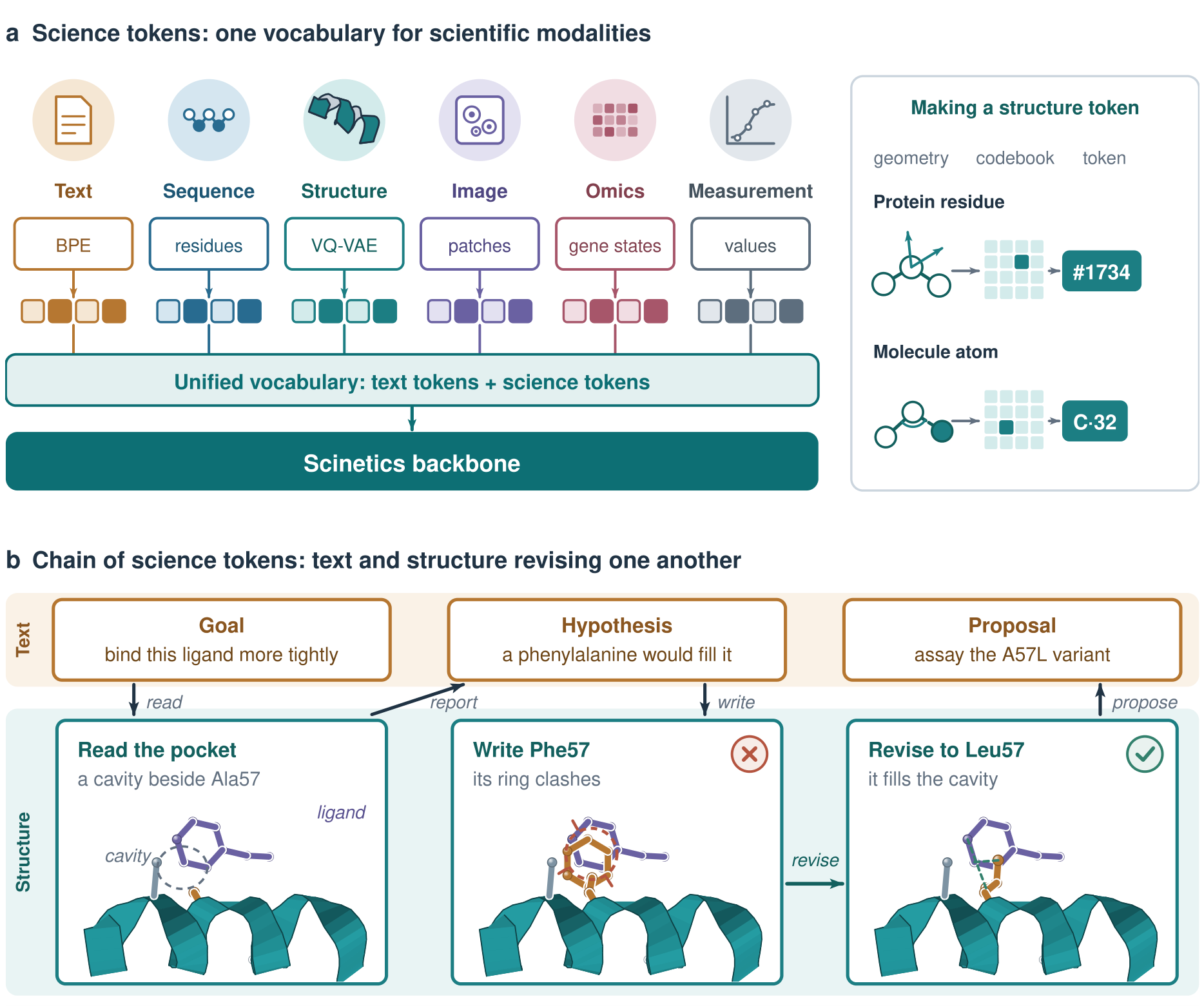
A Chain of Science Tokens imposes a further requirement: scientific objects must genuinely change the subsequent reasoning. In the conceptual example from our Perspective, the model first reads a protein binding pocket and tries to fill a cavity with a larger side chain. A geometric check reveals a clash with the ligand, so the model switches to a more suitable side chain before proposing an experiment.
This “thought process” leaves behind a set of inspectable coordinates. If the pocket geometry changes, the model should adjust its design accordingly; if the same molecule is merely rotated, the conclusion should remain stable. Such tests can help determine whether the model is actually using scientific information.
02 Scientific Super Intelligence must cross two thresholds
Specialized scientific models excel at particular tasks, while general-purpose large language models excel at understanding and reasoning across tasks. We want to explore whether these strengths can coexist in a single model.
In the Perspective, we define Scientific Super Intelligence (SSI) in terms of a “double crossing”: the same fixed model must outperform the relevant domain-specialist models on specialized scientific tasks and outperform general-purpose language models of comparable parameter count on broad scientific reasoning.
For structure prediction, for example, the goal would be to surpass the relevant specialized system under consistent evaluation conditions. Across broader tasks, the model would also need to interpret data, reason quantitatively, write code, and plan experiments. Scientific representations, domain expertise, and general reasoning would therefore need to advance together.
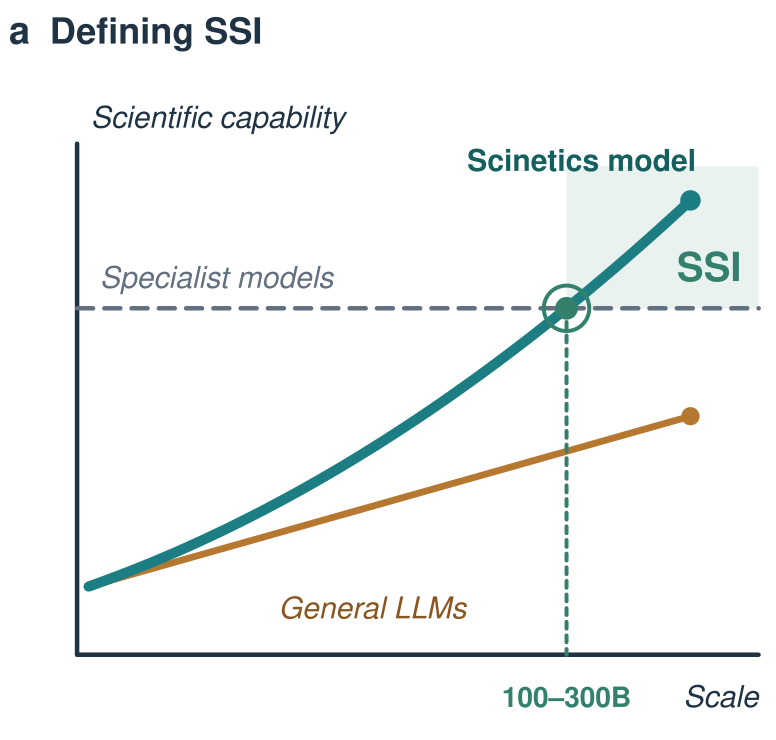
We propose a testable scaling window of 100–300 billion parameters and 10–30 trillion training tokens. This range balances the capacity required for multimodal competence, existing training scales, the volume of scientific data, and computational budgets. It is a research hypothesis for the next stage, not an established optimum.
Testing this hypothesis will require measuring capability curves at multiple model scales and examining whether both thresholds can be crossed simultaneously. Training tokens must also be distinguished from independent evidence: repeatedly training on the same dataset increases computation but does not create new experimental facts. As models grow, high-quality scientific feedback may remain the truly scarce resource.
03 ScienceRSI: using scientific evidence to train the next generation
Scientific data are not short of “results”: databases contain enormous numbers of sequences, structures, and measurements. What is often missing is a complete record of the reasoning process, from formulating a hypothesis and comparing candidates to evaluating evidence. Relying solely on people to write these trajectories is unlikely to meet the training needs of the next stage.
We therefore propose ScienceRSI, or scientific recursive self-improvement: the current generation of models helps produce the training material for the next, while external scientific evidence determines what is worth learning.
The loop begins with smaller models and the scientific agents built on them. Working on real tasks, they formulate hypotheses, generate candidate Chains of Science Tokens, and record the scientific state at every step. Simulators, databases, experiments, and domain experts then participate in verification. The selected trajectories train a stronger next-generation model, which enters the next round of exploration.
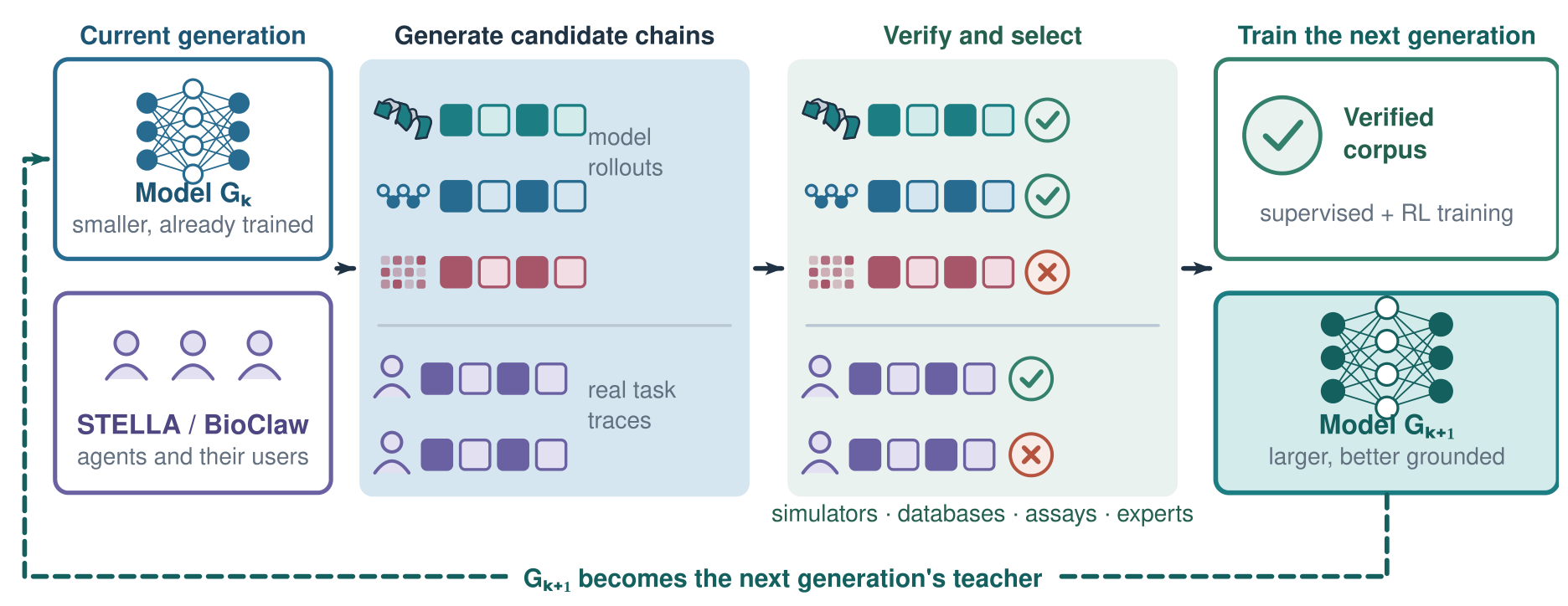
Failures are valuable in this process as well. A structural clash or an irreproducible result can teach the model which paths are not worth repeating. Predictions, simulations, measurements, and independent replications must be labeled separately so that each experience carries a level of confidence appropriate to its supporting evidence.
We care about three practical questions. What fraction of generated candidates pass verification? What fraction of tasks have reliable verification methods? And does the next model generation improve on tasks excluded from training? These correspond to verification pass rate, verification coverage, and gains on independent evaluations.
ScienceRSI is thus a research program that must be tested generation by generation. Its potential depends on whether models can encounter new scientific questions and whether verification tools and experimental feedback can keep pace. Every meaningful improvement should be traceable to stronger evidence and better task performance.
04 From consuming tokens to accumulating scientific assets
Suppose an AI produces two protein sequences of equal length. They may consume the same number of output tokens, but their scientific value can differ dramatically: one is merely a candidate, while the other has been measured experimentally and shown to perform a target reaction under specified conditions.
This is the motivation behind the Perspective’s concept of science-token economics: computational expenditure and the value of scientific outcomes should be assessed separately. Token counts can track computation; whether an outcome is useful depends on its evidence, conditions of validity, and potential downstream applications.
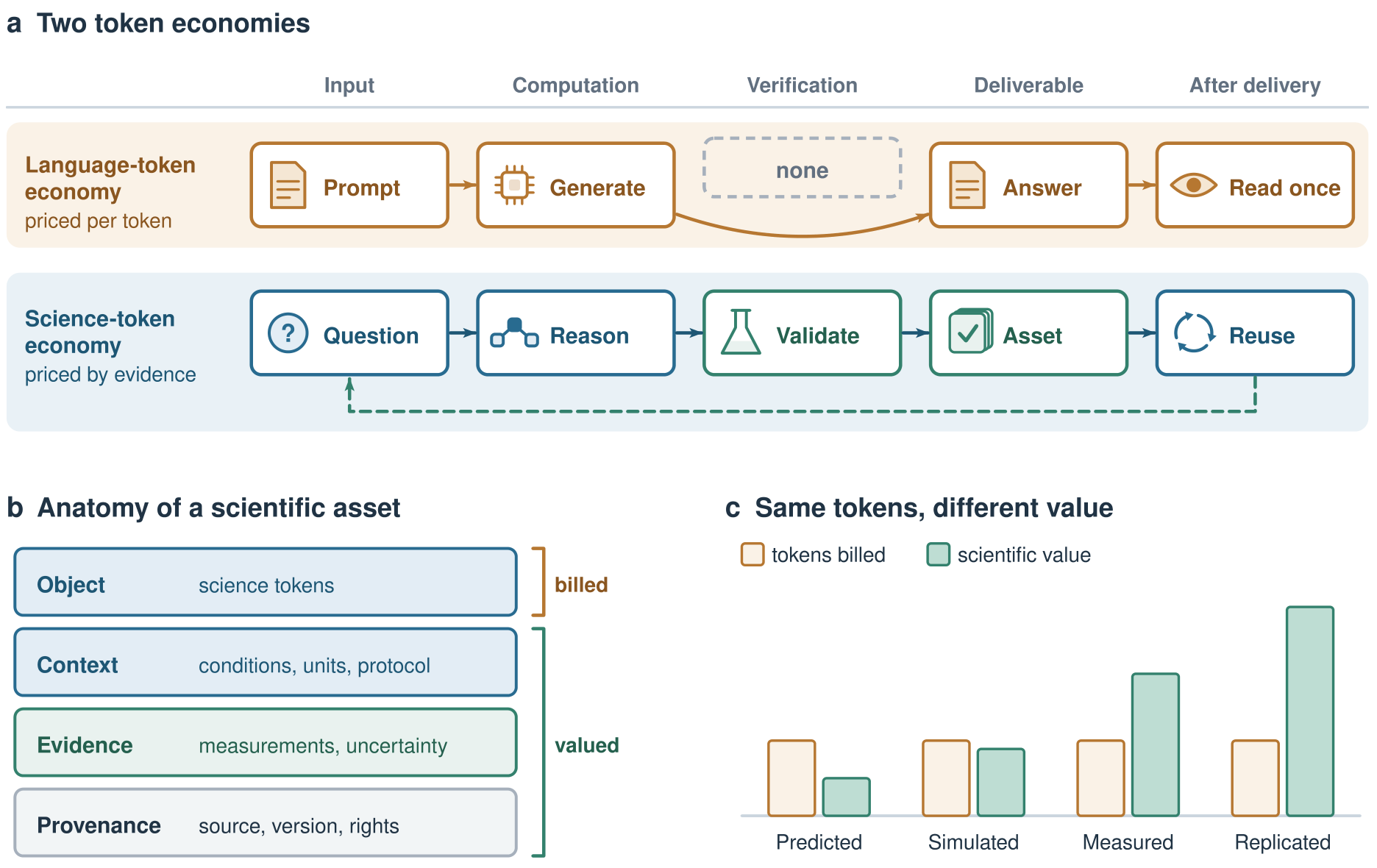
We envision a scientific asset as comprising four parts: the object itself, such as a sequence or structure; its context, such as units, conditions, and experimental protocols; the evidence, such as measurements and uncertainty; and provenance, such as versions, verification records, and permissions for reuse.
As a candidate moves from prediction to simulation, measurement, and independent replication, the evidence attached to it becomes richer. The resulting asset can inform laboratory decisions and enter subsequent model training and evaluation. Negative results and limits of applicability should also be retained.
This suggests another way for scientific AI to grow: every completed task offers a chance to accumulate an outcome that is traceable and reusable. What may matter in the future is how much reliable information these outcomes contribute to the next research effort and how much verification cost they save. We call this scientific value density, while recognizing that specific value must still be judged against the evidence and intended use.
05 A starting point: putting Chains of Structures to work in enzyme design
Where can this roadmap begin in practice? In Chain of Structures (COS), we chose enzyme design as an early case study of scientific spatial reasoning. The work was conducted jointly by researchers affiliated with MIT, Harvard University, the University of Cambridge, the Hong Kong University of Science and Technology, Scinetics, and other institutions.
Starting from a chemical reaction, COS constructs a protein over four rounds: first establishing the catalytic core, then refining the active site, next building the global scaffold, and finally completing the sequence and side chains. Each round produces an explicit structural state and passes the geometric constraints already established to the next. Language-based reasoning and structure generation thus remain connected throughout the process.
In the enzyme-design benchmark reported in the technical report, COS ranked first on five of six metrics. Its third-level Enzyme Commission classification agreement (EC3) reached 57.0%, compared with 55.3% for CodeFP; structural confidence (pLDDT) reached 79.3, and structural self-consistency (TM-score) reached 0.729. Removing the reasoning chain reduced EC3 to 53.4%, supporting the contribution of intermediate reasoning steps.
These results provide preliminary computational evidence; actual enzyme activity still requires wet-lab validation. COS demonstrates a feasible starting point for reasoning through structural chains. Broader Chains of Science Tokens, cross-generation training loops, and the SSI objective will all require further research.
We want every step of scientific AI reasoning to move closer to an inspectable scientific object, and every completed task to become experience that can inform the next study.
FURTHER READING & PROJECT LINKS