Over the past decade, AI for Science has quietly moved through several distinct cycles. “Many people have yet to make sense of the last one, while the next is already gathering beneath the surface,” Zaixi Zhang told Sinovum. Zhang is an Assistant Professor in the Department of Chemical and Biological Engineering at the Hong Kong University of Science and Technology, and the founder and CEO of Scinetics. The company has completed its first round of financing.
In 2019, AI4S was still a niche field. The prevailing approach was straightforward: identify a specific scientific problem, design an algorithm, and train a model to solve it—predicting a material property, for example, or designing a protein sequence.
Zhang, then a PhD student, chose to work in the field anyway. AI4S was in its first cycle: building one key for every lock.
The defining achievement of that cycle was AlphaFold2, which addressed the protein-structure prediction problem that had challenged biologists for half a century. Zhang also produced a succession of leading models during this period: MGSSL for molecular screening, FLAG for drug-like molecule generation, PocketGen for protein design, and RNAGenesis for RNA therapeutic design. Each reached state-of-the-art performance in its respective domain.
Yet the more models he built, the clearer the limitation became: excellence at an individual task is not the same as the capacity for scientific discovery.
A complete protein-drug design project may require coordinating more than twenty tools through repeated rounds of iteration. However capable AlphaFold may be, it addresses only one step. Zhang compares this to the barrel effect: “Making one stave taller does not allow the barrel to hold more water.”
The field soon reached the same conclusion, and AI4S entered its second cycle: the era of scientific agents.
Large language models began to act as orchestration layers for research, connecting specialized models, databases, and experimental tools into unified workflows. If a specialized model is an expert in one narrow discipline, an agent is closer to a project manager: it may not perform every task itself, but knows which tool to use and when. During this period, Zhang and his team developed scientific agents including STELLA and BioClaw, and brought related technology into LabOS, an operating system for laboratories.
But agents still do not solve the most fundamental problem. Most agents today remain language models that orchestrate external tools.
They can call a protein model without truly understanding three-dimensional structure. They can read the output of an omics analysis without being able to reason directly over the vast, sparse matrix underneath it. Scientific data has its own languages—nucleotide sequences, three-dimensional structures, expression matrices, and microscopy images—while an agent’s native languages are text and code. The entire workflow therefore becomes an exercise in repeated translation. Information is lost at every translation, and errors compound along the task chain.
“Specialized models solve individual points, and agents connect many points. What is still missing is a model that genuinely understands the scientific world.” After working through several cycles of AI4S, Zhang is betting on a multimodal reasoning foundation model for the next one. “Scinetics is building a multimodal foundation model in which DNA, RNA, protein structures, omics matrices, microscopy images, and experimental records enter the model directly—as native languages, without first being translated into text.”
On that foundation, a model could perform long-horizon reasoning across multimodal scientific data. Zhang calls this a “Chain of Science Tokens”: a continuous chain of reasoning for solving system-level scientific problems. The first version is designed for life science, with materials science, quantum physics, aerospace, and chip design intended to follow.
Major international AI companies have already begun moving into the field.
Anthropic introduced Claude for Life Sciences in October 2025, embedding Claude into life-science workflows. OpenAI launched GPT-Rosalind for biological reasoning in April 2026, followed in June by Anthropic’s Claude Science workspace for researchers. Google DeepMind, meanwhile, has Gemini for Science and Isomorphic Labs, whose work extends into drug design. After language, code, and general multimodality, science is becoming the next frontier of foundation-model competition.
There is little doubt that the next AI4S cycle is already taking shape.
From ten minutes to twenty years
A national immunology laboratory had spent nearly twenty years studying acute myeloid leukemia. The blood cancer has a relapse rate of 70–80 percent, yet there are very few viable targets. Designing drugs around established targets leaves some side effects unavoidable because of the constraints imposed by genetic pathways and regulatory networks. Finding new targets had become urgent.
“They eventually came to me. After STELLA was deployed privately, it returned a candidate list within ten minutes. The top-ranked target had never appeared in the literature and had never been tested experimentally. The laboratory then validated it across several cell lines and obtained promising preliminary results. They are now designing antibody therapeutics around it,” Zhang said. He hopes the program will eventually enter the clinic.
For human researchers, the same work would involve literature searches, database comparisons, and initial candidate screening. “It usually takes days or weeks, and there is no guarantee of finding a meaningful lead.” The difference between ten minutes and several weeks is not simply one of speed. STELLA’s highest-priority candidate fell outside the directions that the team had emphasized during two decades of research. More importantly, it demonstrated a broader possibility: AI might do more than accelerate search and analysis. It could expand the scientific hypothesis space and propose directions no one has tried, but that are worth testing. STELLA launched in July 2025, and Zhang describes it as the first self-evolving agent for life science.
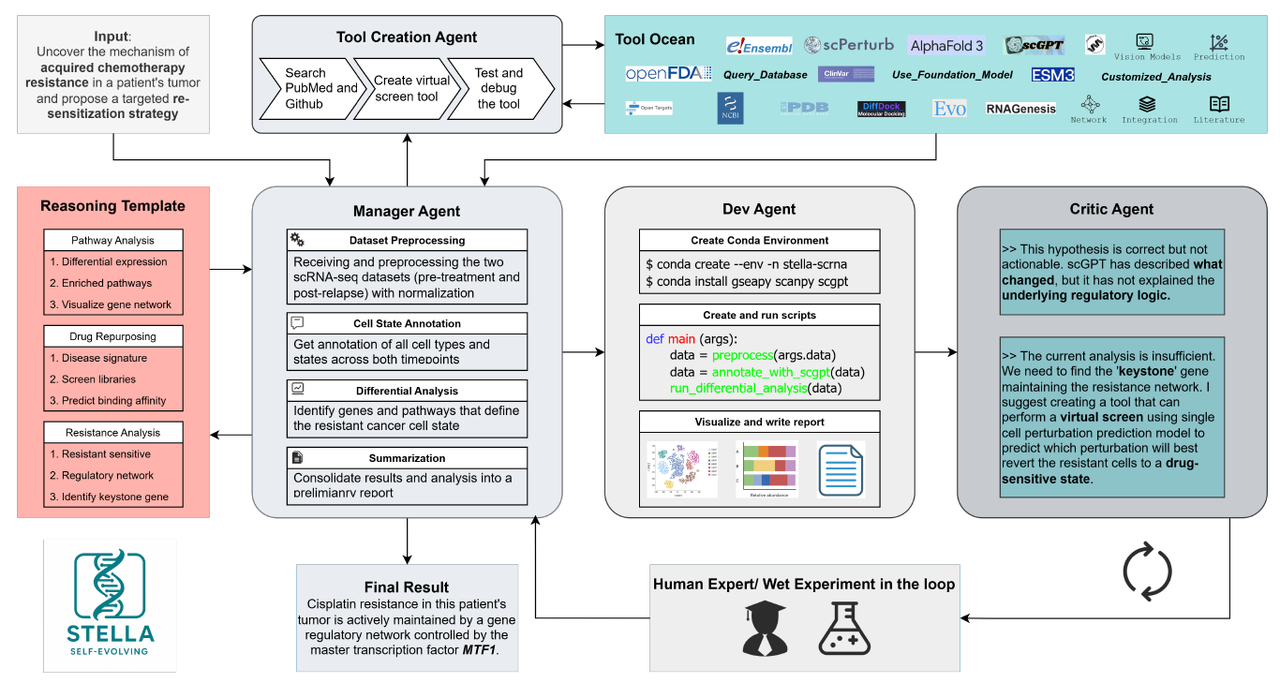
“Self-evolving” means that the system does more than call existing models and tools. It learns from task feedback, distilling successful and unsuccessful paths into reusable reasoning patterns for future tasks.
STELLA’s ability to propose an untested target in ten minutes rests on five years of work on specialized models. MGSSL, introduced in 2020, pretrained on molecular motifs for molecular screening. FLAG, released in 2022, generated small molecules for a given target protein. PocketGen followed in 2023 for protein-pocket design, and RNAGenesis in 2024 used an RNA foundation model to design oligonucleotide therapeutics. The four models correspond to four stages of life-science R&D, and each achieved leading performance at the time.
PocketGen is regarded as the first algorithm to jointly design the sequences and structures of protein pockets. In an expert commentary for Science, Scripps Research Translational Institute founder Eric Topol discussed it alongside AlphaFold 3. Its experimental results surpassed the RFDiffusion series then available from Nobel laureate David Baker’s team.
But reaching that level with individual models also exposed their limit: no matter how capable a model is at one task, it cannot cover an entire research workflow. Zhang therefore turned to scientific agents—a direction the academic community has also identified as promising. Nature Methods named AI agents for science among its methods to watch.
Around STELLA, Zhang and his team built two further systems. The first was BioClaw, which brings the agent into messaging applications. Zhang demonstrated one scenario to Sinovum: researchers are discussing RNA-seq results in a group chat. They mention BioClaw, upload deseq_results.csv, and ask it to draw a volcano plot, label genes with an FDR below 0.05, and return the number of differentially expressed genes, their direction of regulation, and priority candidates.
BioClaw also has web and locally deployable versions. Messaging integration lets researchers move work forward wherever they are. “Even when we are away from the laboratory, we can check experimental progress from a phone,” Zhang said. Computation runs in local containers, so sensitive data is not uploaded—a firm requirement for many laboratories. The BioClaw community now has more than 1,200 members and has received over 500 applications from potential contributors. It has also established a collaboration with the US-listed biotechnology company Ginkgo Bioworks.
The second system was LabOS, which brings agents into the physical laboratory by integrating agents, embodied modules, vision models, and wearable devices. Zhang is a co-first author of the work, which was presented at NVIDIA GTC and CES in 2026.
After completing all of this, however, Zhang encountered the ceiling of the agent approach. His assessment of recently launched general-purpose scientific agents is the same as his assessment of his own systems: they operate more like libraries for calling tools. When asked to generate a genuinely new scientific hypothesis, they either hallucinate too freely or remain excessively conservative.
“A great deal of information is lost during tool calls and conversions, creating errors. The reasoning unfolds step by step, so errors accumulate—and by the end they can be greatly amplified,” Zhang said. Moving forward requires another step.
Scientific Tokens: a unit for scientific intelligence
The first challenge for the next generation of AI4S foundation models is to transform scientific data that currently speaks in separate languages—structures, sequences, omics, images, literature, experimental procedures, and wet-lab measurements—into fundamental units a model can understand and process together.
The model would no longer see isolated pieces of text, sequences, and images. It would see different aspects of the same scientific problem and reason directly across them. Zhang calls the fundamental units of these scientific modalities “Science Tokens.” He first presented the concept publicly at the Artificial Intelligence and Biomedicine Ecosystem Conference in Shanghai in July 2026.
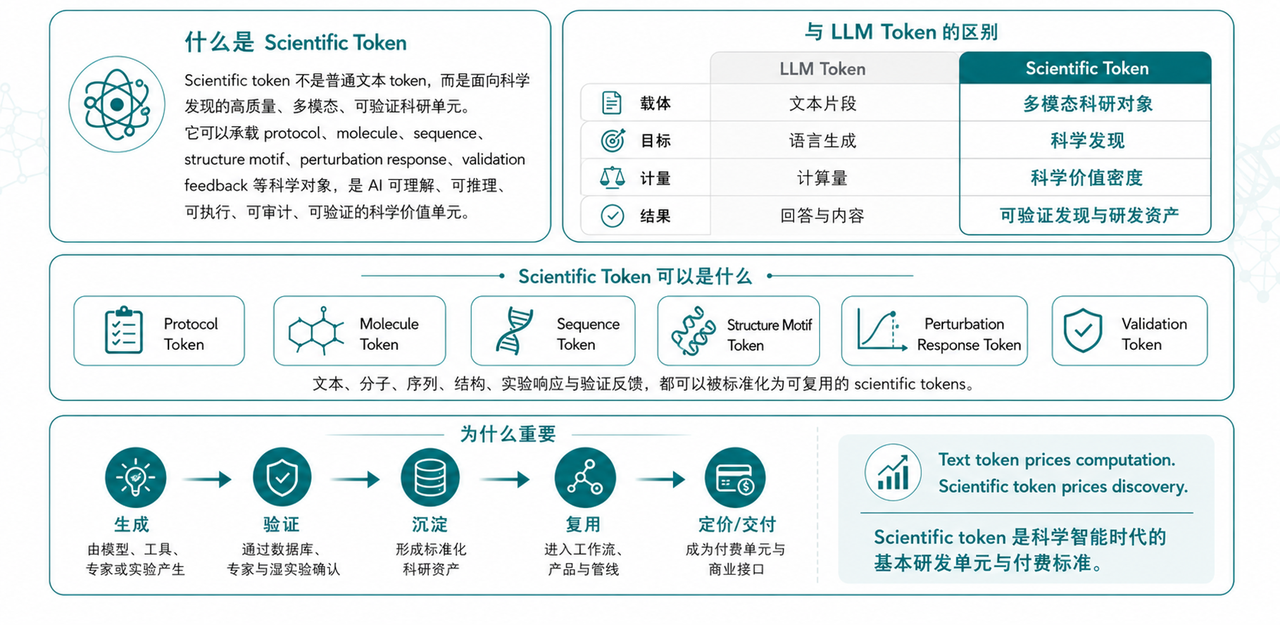
The first version of the Scinetics foundation model will focus on the central dogma of life science: DNA to RNA to protein, and onward to function and phenotype. Different modalities will be processed within a single model and aligned in a shared representation space, enabling long-horizon reasoning across them.
Zhang frames the ambition in four transitions: from language tokens to scientific tokens; from tool use to scientific discovery; from offline prediction to experimental validation; and from static models to self-evolving systems. He calls the destination AI for Science’s “ChatGPT moment.”
The crucial difference from an agent lies in the level at which reasoning happens. Zhang imagines a scientific foundation model that unifies capabilities now distributed across vertical models such as AlphaFold and ESM, reducing the information lost through repeated model calls and format conversions. The objective is to “reason directly in the space of proteins, rather than being limited to reasoning at the level of text.”
Zhang is candid about what can be achieved today. “With a transformation like AlphaFold, something that people once expected to fail 90 percent of the time now succeeds 90 percent of the time.” In antibody design, the current industry standard—including Scinetics’ best models—is often one or two successful sequences out of ten. That already represents state-of-the-art performance. He hopes foundation models can raise benchmark tasks of this kind to success rates of 80 or 90 percent.
Before AlphaFold, researchers relied on cryo-electron microscopy and X-ray crystallography to determine protein structures. After AlphaFold, structure prediction became a tool researchers could directly rely on in many settings for the first time. But moving from 10 percent to 80 percent is an order-of-magnitude leap, and there is no evidence yet that it can be crossed. Ultimately, the outcome will depend on data.
For the industry, scientific tokens carry a longer-term possibility: becoming standardized units of delivery and pricing. Tokens in today’s large language models measure computational consumption. Zhang hopes scientific tokens might eventually correspond not only to compute, but to the value of discovery produced by a scientific task.
He summarizes the idea in one line: “Text tokens price computation. Scientific tokens price discovery.”
This pricing framework remains exploratory. There are no settled answers to who defines the value of a scientific discovery, how that value should be measured, or how it could be priced before delivery. For Zhang, however, the significance of scientific tokens goes beyond a new model representation. It is also an attempt to establish a unified technical and delivery standard for AI for Science.
“The hardest link is at the bench”
However capable the models and however good the data, half of the scientific loop still takes place at the laboratory bench—and that is the part most difficult to accelerate.
The obstacle is not a lack of equipment. Ginkgo Bioworks in the United States and many companies in China already offer mature automated-laboratory systems. The problem is that this equipment is mainly designed for high-throughput, highly standardized workflows. Once a protocol changes, reconfiguring the equipment and software becomes expensive. “After completing one experiment, moving to another can require extensive reconstruction of both the program and the workflow,” Zhang explained. Yet exploratory, customized experiments are often the most valuable part of research.
Scinetics’ answer is a scientific embodiment platform: a sandbox containing more than 200 types of laboratory instruments, where models can iterate and self-evolve. This environment is used to train Agentic-VLA and a family of other embodied scientific models. In practical terms, the agent manages the training of robotic arms.
A two-armed robot opening a centrifuge tube is taught as four steps: grasping, alignment, engaging the threads, and twisting. The agent writes its own inspection tools to determine whether each step was completed correctly, then writes recovery tools that retry after a failure. Those correction trajectories are subsequently used to fine-tune the robot’s policy model.
In partner laboratories, models including Agentic-VLA can already complete a continuous series of enzyme-activity assays. Stable operation is still measured in hours. “Over longer periods, errors can arise quite easily, so human supervision and correction remain necessary,” Zhang said.
He also points to a category of experimental data that is systematically wasted: failed experiments and intermediate results. Published papers contain final outcomes, while synthesis yields, reaction rates, and intermediate images are rarely organized into feedback that models can use. In a collaboration with a Chinese synthetic-biology company, Scinetics deployed equipment specifically designed to collect intermediate data. “One use is early assessment. During protein synthesis and optimization, it may not be necessary to wait until the final step to know whether a sequence is useful,” he explained.
As models, data, and experiments begin to form a closed loop, the question is no longer only how to make the system more capable. Another becomes increasingly concrete: where should the boundaries of that capability lie?
“The answer is also in our company’s name,” Zhang said. “Scinetics combines science and cybernetics: the cybernetics of future scientific systems.” His understanding of cybernetics has two layers—making a system stronger, and defining the boundaries of its capabilities.
The more powerful and accessible the capability becomes, the more important the second layer is. Finding an untested therapeutic target in ten minutes and finding something that should not be found in ten minutes draw on the same underlying capability.
Zhang began working on this problem early. In 2024, he proposed the idea of generative biosafety, publishing both research and perspective papers in the area. He was also a core organizer of the NeurIPS 2025 workshop on biosafety safeguards for generative AI.
What role, then, do humans play in such a scientific system?
Zhang believes humans remain in control at this stage. Agents and large models already perform basic scientific data analysis well, but “the direction to pursue, and the overall taste in research, are still led by people.” He hopes agents will ultimately be able to formulate hypotheses and explore proactively—moving “from passively fitting existing data to becoming protagonists that create knowledge and lead discovery.” For now, however, we remain in an early era of human–AI collaboration.
An assistant professor spanning physics, biology, and AI
The view of a system as something that can be both regulated and constrained can be traced back to Zhang’s undergraduate education.
He studied physics in the School of the Gifted Young at the University of Science and Technology of China, then remained at USTC for a PhD in artificial intelligence under Professor Qi Liu. During his doctorate, he also trained at Harvard Medical School with Professor Marinka Zitnik, a leading scholar in biomedical AI. He later conducted postdoctoral research with Professor Mengdi Wang at the Princeton AI Lab.
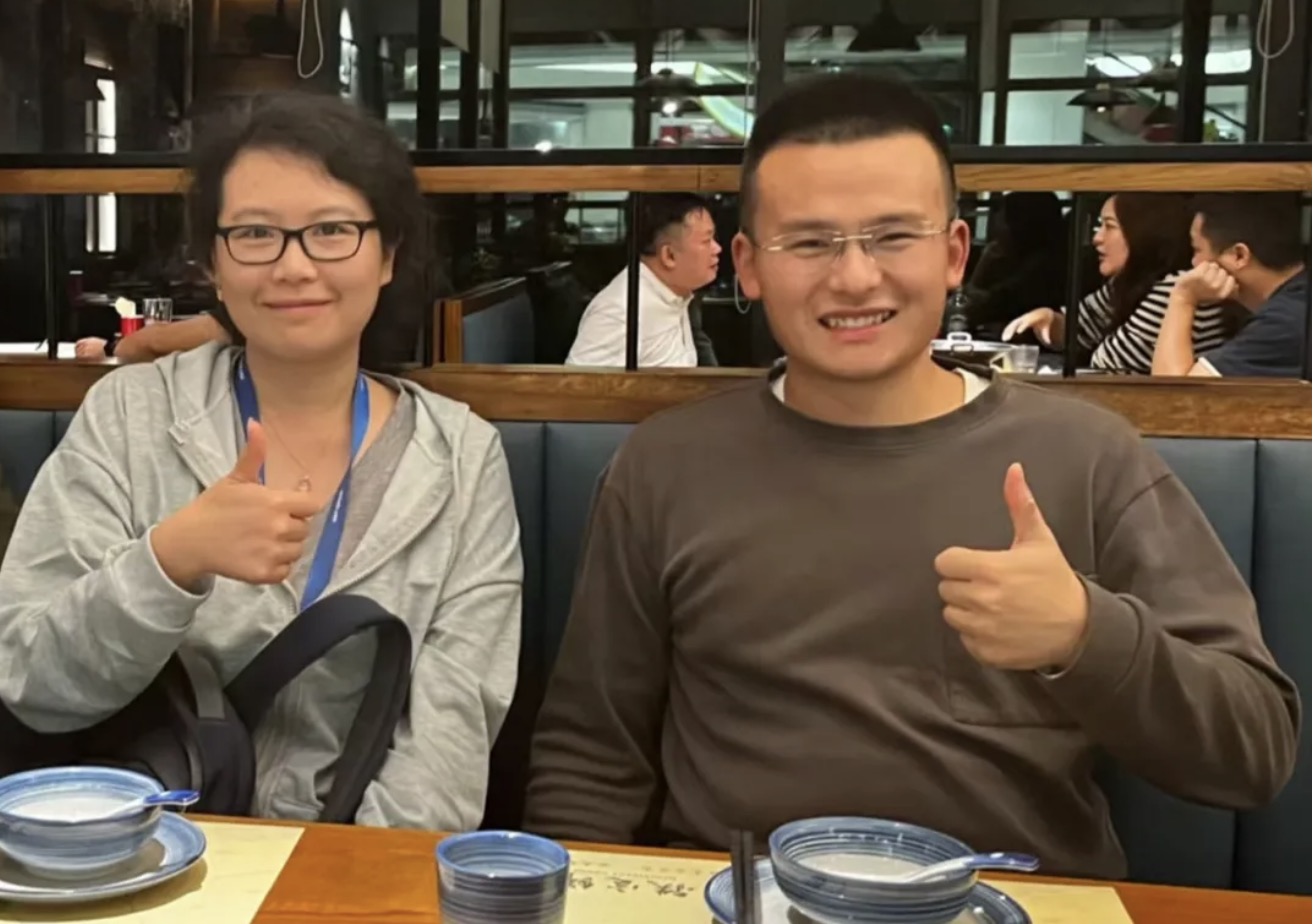
Zhang has also worked at Tencent Quantum Lab, Microsoft Research Asia, and BioMap.
Before returning to China, he held more than ten faculty offers from universities in China and abroad. One top-20 US university offered a startup package of approximately US$3 million, among the largest it had extended to a newly appointed assistant professor. He also received offers from major technology companies and frontier AI laboratories with annual compensation in the tens of millions of renminbi.
He ultimately chose HKUST and founded the HKUST Scientific AGI Lab. The university offered greater room to build and had a strong entrepreneurial culture. Zhang points to examples including Li Zexiang and DJI—research moving from a university setting into industry. In his view, professor and entrepreneur are not identities that must be pursued one after the other. Both can serve the same objective: moving AI for Science from papers and models into real scientific systems. “I went to HKUST with the intention of starting a company,” he said.
Zhang distinguishes the path from AI for Science to AGI from the path pursued by general-purpose AI alone.
In his view, AI for Science is not a one-way transformation of science by AI. It is a bidirectional cycle: AI first accelerates scientific discovery, then the resulting experiments, discoveries, and data train stronger AI. The two evolve together within the same closed loop. That also makes the path “considerably more complex.”
The complexity is not only technical. For an AI for Science company, another challenge is making long-term investment in technology compatible with near-term commercialization.
Zhang does not avoid that tension. AI4S foundation models require sustained investment, while the company must also establish a durable commercial loop through enterprise partnerships. “Before we truly reach Scientific AGI, AI for Science will pass through several more cycles. We are prepared to navigate them with a long-term perspective,” he said.
This article is republished from the Sinovum WeChat channel. Copyright belongs to the original publisher. Please contact us with any rights-related concerns.
For research collaborations, commercial partnerships, product access, or other inquiries, contact us at info@scinetics.ai.