
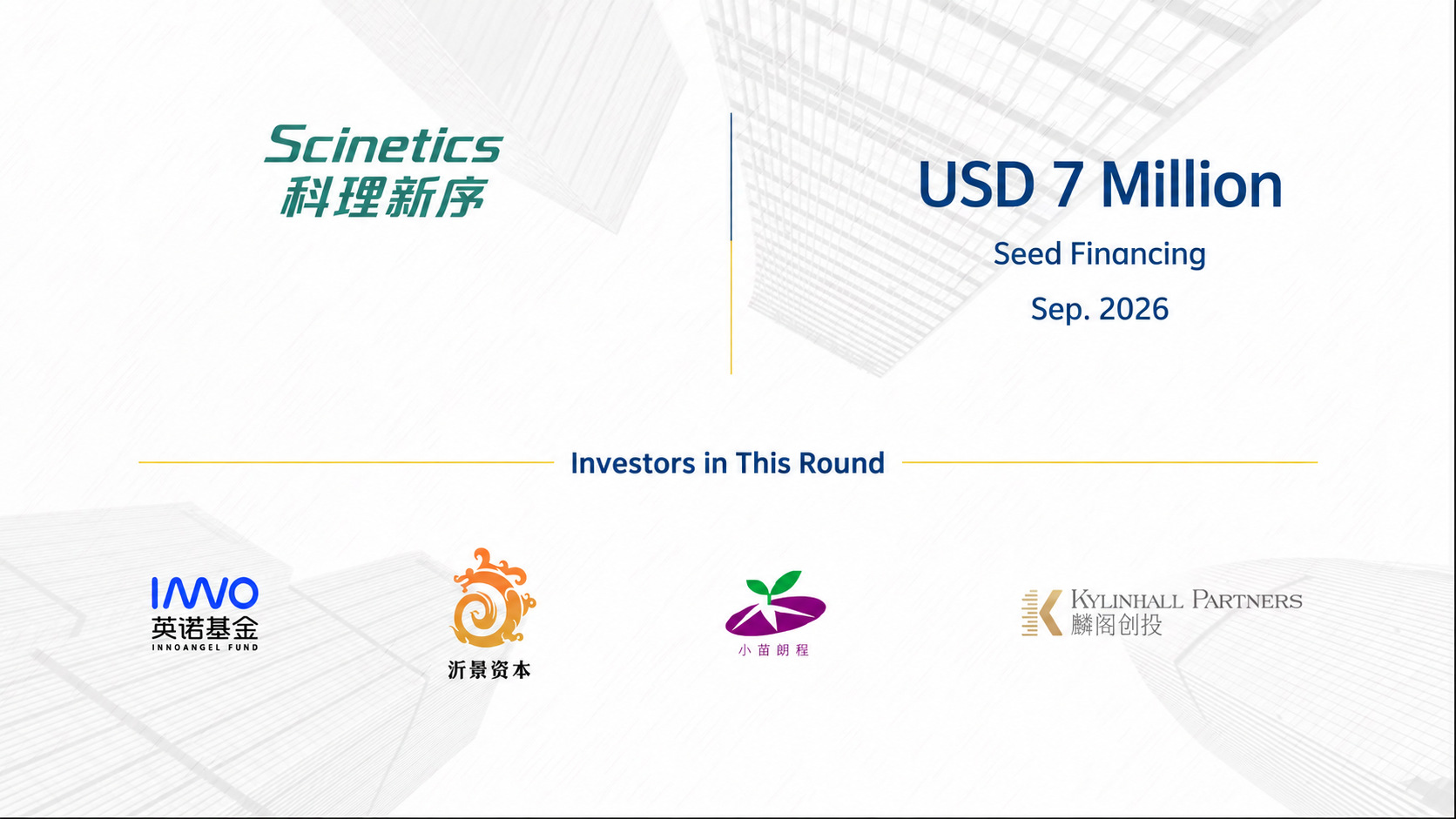
Recently, Scinetics completed its first round of financing of nearly USD 7 million. The round was led by InnoTech Fund, with participation from Yijing Capital, Shanghai Xiaomiao Longcheng Investment Management Co., Ltd., and Kylinhall Partners. Lighthouse Capital served as strategic incubator and sole financial advisor. The proceeds will be used primarily to iterate Scinetics' AI4S scientific foundation model and expand its core team.
Scinetics is an AI for Science company focused on scientific discovery. It is building a self-evolving scientific intelligence system driven by two engines, an AI4S foundation model and Physical AI, with the goal of closing the dry-wet loop of cognition, design, experiment, feedback, and relearning.
From Single-Point Models to Foundation Models
Scinetics founder, CEO and CTO Zaixi Zhang received his bachelor's degree in Theoretical and Applied Mechanics from the School of the Gifted Young at the University of Science and Technology of China (USTC), and his Ph.D. in Computer Science from USTC under Professor Qi Liu. He also trained jointly at Harvard Medical School under Professor Marinka Zitnik and completed postdoctoral research at the Princeton AI Lab under Professor Mengdi Wang. After completing his Ph.D., he received faculty offers from more than ten leading universities in China and abroad, as well as compensation offers in the tens of millions of RMB from major Chinese technology companies. In July this year, he joined The Hong Kong University of Science and Technology (HKUST) as an assistant professor with joint appointments in the Department of Chemical and Biological Engineering, the Department of Computer Science and Engineering, and the School of Medicine.
Since 2019, Zhang's team has produced a series of representative AI4S systems, including the molecular screening model MGSSL, the molecular generation model FLAG, the protein-pocket design model PocketGen, and the RNA design model RNAGenesis, achieving state-of-the-art performance in multiple vertical domains. The team nevertheless concluded that single-point models could not cover the full scientific discovery process.
The team then moved into scientific agents, developing systems including STELLA and BioClaw. The BioClaw community has grown to more than 1,200 members and received more than 500 co-creator applications, while the team has also established a collaboration with Ginkgo Bioworks in the United States. STELLA has served more than 1,000 research users; domestic users include national key laboratories and university research institutes, while 70% of international users come from leading institutions such as Stanford, Princeton, Harvard, and MIT.
After single-point models and scientific agents, the team is placing its next bet on an AI4S scientific foundation model: a model that can reason directly in scientific spaces such as proteins and molecules, rather than operating only at the text layer to orchestrate tools. The first version will focus on the central dogma of life sciences, from DNA to RNA to proteins, and then to function and phenotype.
A Case Study
A national laboratory that has studied acute myeloid leukemia for nearly two decades had struggled to identify a new breakthrough among existing targets. The team used STELLA to search for new targets. After private deployment, the system returned a candidate list within ten minutes. The top-ranked target had previously lacked direct literature reports and experimental validation. The laboratory subsequently validated it across multiple cell lines and obtained preliminary positive results, and is now designing antibody therapeutics around the target.
Automated Experiment Platform
Scinetics is building a sandbox environment covering more than 200 types of laboratory instruments and training a family of Agentic-VLA (vision-language-action) models that enable agents to directly control robotic arms, decompose experimental procedures, monitor execution in real time, and autonomously correct errors. The system has been demonstrated at events including NVIDIA GTC and CES.
At the same time, the team is addressing the systematic loss of failed and intermediate experimental data by deploying dedicated data-capture devices to collect intermediate states and identify optimization directions earlier.
Looking ahead, Scinetics aims to build an AI Scientist that can understand science, proactively generate hypotheses, conduct experiments autonomously, and continuously evolve. In Zhang's view, AI for Science is not a one-way process in which AI transforms science, but a two-way cycle: AI first accelerates scientific discovery, and new experiments and discoveries then train stronger AI. Starting from life sciences, the company plans to expand gradually into materials science, quantum physics, aerospace, chip design, and other scientific domains.
Investor Perspectives
InnoTech Fund, the lead investor, said: "Scinetics' system of a self-evolving AI scientist and closed-loop dry-wet laboratory directly addresses a core bottleneck in AI4S: general-purpose foundation models lack physical-world validation in experimental sciences. Led by Dr. Zaixi Zhang, an alumnus of USTC's School of the Gifted Young, the team uses STELLA and LabOS as core systems to connect hypothesis generation, experiment design, and robotic execution in an autonomous loop, moving AI from prediction toward execution. We strongly believe in the team's ability to advance the era of AI-native research and look forward to Scinetics becoming a benchmark company in AI4S."
Dr. Qin Shen, Managing Director of Yijing Capital, said: "AI4S is becoming an increasingly visible arena of international competition. Whoever first closes the loop from scientific cognition and solution generation to automated experimental validation and data feedback may gain a leading position in the future of scientific discovery and industrial innovation. We believe Scinetics' integration of a science-native AI4S foundation model with a Physical AI execution engine, together with the team's strength across research, industry, and engineering, gives it a rare opportunity to build a platform company."
Peizhou Zhao, Partner at Xiaomiao Longcheng, said: "The transition in AI4S from point tools toward scientific foundation models and self-evolving closed loops is a major trend. Scinetics uses Scientific Tokens to unify multimodal scientific data and combines an AI4S foundation model with Physical AI to connect computational and wet-lab experimentation. The path is clear, and Dr. Zaixi Zhang and the team bring a rare combination of academic depth and engineering execution. We look forward to Scinetics becoming a leading infrastructure provider for general scientific intelligence."
Kylinhall Partners said: "AI4S is moving from point capabilities toward system-level scientific intelligence. Its long-term value lies not only in stronger models, but in connecting models, agents, experiments, and real scientific data. Scinetics has deep AI4S research experience and, through STELLA and BioClaw, has served researchers around the world while accumulating real research-interaction data from leading universities and institutions. This provides an important foundation for continuous training and iteration of its scientific foundation model. We believe in the team's ability to connect research scenarios, models, and experimental feedback into a compounding long-term flywheel."
Hong Lei, Partner at Lighthouse Capital, and Zhengwei Li, Managing Director, said: "Congratulations to Scinetics on completing its first round of financing of nearly USD 7 million. The project was jointly advanced by Lighthouse Capital's Future Technology and Intelligent Life Sciences teams. As strategic incubator and sole financial advisor, Lighthouse has worked closely with Scinetics from day one and witnessed the team's growth. We have long believed that scientific discovery will be the next major frontier for AI capability. Scinetics' shift from language tokens to scientific tokens, and its closed loop of cognition, design, experiment, feedback, and relearning, mirrors the industry's transition from point tools toward foundation models and autonomous experimental systems, and from prediction toward execution. Led by Dr. Zhang, the team combines strong scientific judgment, a complete foundation-model technology stack, and engineering execution. We will continue to support the team as it starts from life sciences and expands into broader scientific discovery, with the ambition to become a leader in AI4S foundation models."
Founder Quote
"We firmly believe that science is the next coding, and scientific discovery will become the next major arena for AI capability breakthroughs," said Zaixi Zhang, founder, CEO and CTO of Scinetics. "Through our AI4S foundation model, we hope to explore and unlock the scaling laws of scientific intelligence, allowing models to continuously improve their ability to understand science, generate hypotheses, and validate discoveries as data, compute, and experimental feedback accumulate. Our goal is to move toward general scientific intelligence and fundamentally expand humanity's ability to explore science. We want Scinetics to become a leader in AI4S foundation models. The path to Scientific AGI will not happen overnight, and AI for Science will go through multiple cycles. We are prepared to pursue this with a long-term mindset. We are grateful to InnoTech Fund for its trust and support, and to every member of the team exploring this frontier with us."
About Scinetics
Scinetics is an AI for Science company focused on scientific discovery. Powered by an AI4S foundation model and Physical AI, the company is building a self-evolving scientific intelligence system that connects cognition, design, experiment, feedback, and relearning. Its core team includes members from Harvard University, Princeton University, the University of Cambridge, USTC, Google DeepMind, Microsoft, Tencent, Huawei, and other leading research and technology organizations. Scinetics is starting in life sciences and plans to expand gradually into materials science, engineering, and other scientific domains.
REPRODUCED FROM 36KR / WAVES
AI4S May Have a Trillion-RMB Future Comparable to Coding
In May this year, 28-year-old Zaixi Zhang concluded his postdoctoral research at Princeton and returned to China. Several doors were open to him at once: faculty positions at US universities, chief scientist roles at major AI companies, and compensation packages in the tens of millions of RMB. He ultimately chose to join HKUST as an assistant professor and take the narrower, less certain path of entrepreneurship, founding the AI for Science company Scinetics.
Waves has learned exclusively that Scinetics recently completed a first round of financing of nearly USD 7 million. The round was led by InnoTech Fund, with participation from Yijing Capital, Xiaomiao Longcheng, and Kylinhall Partners.
This may have been one of the few genuine forks in Zhang's otherwise unusually direct path: from USTC's School of the Gifted Young, to a direct Ph.D., joint training at Harvard Medical School, and then postdoctoral research in Mengdi Wang's group at Princeton. Young principal investigators working in AI4S have become one of the profiles most sought after by venture investors today.
Even so, the decision to start a company was not easy.
Joining a major technology company would have meant more abundant compute, data, and talent. Becoming a university PI while building a startup meant independently finding people, capital, and resources, with uncertainty on both the technical and commercial sides.
What ultimately pushed Zhang to decide was autonomy. He wanted to lead his own research direction rather than be constrained by a larger organization, and he enjoyed building a system from zero.
Before founding Scinetics, Zhang and the team had built the scientific agent STELLA. After launching last year, STELLA served more than 1,000 researchers, with more than 70% of international users coming from institutions such as Stanford and Princeton and other leading laboratories. Compared with training a foundation model from scratch, agents are faster to deploy, easier to integrate into existing R&D workflows, and easier to commercialize.
But this lighter path still has limits. When scientific agents use large language models as their reasoning engines and encounter data such as protein structures or nucleic-acid sequences, they first translate the problem into natural language and then hand text instructions to external models or tools. Fine-grained three-dimensional structure and cross-modal relationships can be lost during repeated translation, and even dozens of agent interactions may not recover the missing information.
During his Ph.D., Zhang developed systems including the molecular screening model MGSSL and the molecular generation model FLAG, achieving state-of-the-art results in several vertical areas. Yet he concluded that point capabilities were not enough and that AI4S would ultimately move toward multimodality. Scinetics therefore chose to build a multimodal foundation model for long-horizon scientific reasoning.
He proposed the concept of the "Science Token": converting scientific data such as small molecules, nucleic acids, and protein structures into unified representational units for the model, without translating everything through human language, so that the model can reason directly in native scientific modalities.
In the near term, the company will focus on life sciences, where commercialization pathways are clearest, before gradually expanding into materials science, engineering, and other domains.
Looking ahead, Zhang believes AI4S will have its own GPT moment and its own coding moment, and that the market could eventually be even larger than coding. He also believes his small team has an opportunity to build a unified scientific foundation model and become an AI4S foundation-model company analogous, in positioning, to DeepSeek or Anthropic.
At the beginning of a technological revolution, technical routes have not yet converged, which is precisely when startups can take asymmetric bets. We recently spoke with Zhang about what future he is betting on by entering AI4S now.
Edited interview:
01: AI4S, a Trillion-RMB Market Comparable to Coding
Waves: In 2019, at age 21, you chose AI for Science as your Ph.D. direction. Looking back, that seems prescient. What has it felt like to watch the field go from niche to hot?
Zaixi Zhang: I was fortunate. My career transition happened to coincide with the field's inflection point.
When I was doing my Ph.D., AI4S was not a consensus field. The prevailing view was "Science + AI": AI was an auxiliary algorithmic tool for improving efficiency, and projects were expected to bind tightly to a specific drug pipeline, such as peptide therapeutics or a narrow protein-modeling task.
Now AI4S is moving in a more general direction, and the market increasingly expects the field to have its own "coding moment." Coding gave humans the ability to create in the digital world; AI4S changes our underlying ability to explore science and discover new knowledge. Its market value could be comparable to, or even exceed, coding.
The evolution from AlphaFold 1 onward makes it clear how quickly AI capabilities are improving. The scientific questions themselves have not fundamentally changed, but new algorithms have made previously intractable modeling and prediction problems solvable, while incorporating more scientific modalities has continued to strengthen model capabilities.
Waves: Science is extremely broad. What are the main startup and investment routes in AI4S today? Are the technical approaches beginning to converge?
Zaixi Zhang: Objectively, there is still a lot of noise in AI4S. People tend to build around their previous backgrounds, and there is not yet a consensus technical route, so it is too early to say which approach is best.
The first route is scientific agents, which mainly complete scientific tasks by invoking external tools. Their advantage is rapid deployment: they can be integrated into existing R&D workflows quickly and have short commercial validation cycles, which is why many startups have emerged around this approach.
Large technology companies are also exploring this, such as Anthropic with Claude Science and OpenAI with GPT-Rosalind. But their primary battlegrounds remain more general domains such as coding, while science is still a comparatively early strategic exploration.
The second route is the virtual cell. Interest in virtual-cell models rose sharply last year, influenced in part by work from the Arc Institute and related research. In principle, virtual cells simulate how cells respond to drugs or gene editing, enabling ineffective candidates to be screened out earlier and reducing R&D time and cost. Expectations are high, and progress is fast.
The third route is the one we chose: an AI4S foundation model. It is a bottom-up approach that starts from molecular interactions and attempts to infer higher-level phenomena such as disease mechanisms and gene-regulatory networks.
Waves: You launched STELLA last year and reportedly received strong feedback. Why not stay with the lighter scientific-agent route?
Zaixi Zhang: STELLA served more than 1,000 researchers after launch, and more than 70% of international users came from leading universities and laboratories such as Stanford and Princeton. Professor Feng Zhang at MIT has also used it.
But we found a fundamental limitation in the scientific-agent paradigm:
It translates a scientific problem into natural language for a language model to understand, and then translates the result back into structured instructions for tools to execute. Fine-grained three-dimensional structural information and subtle relationships between modalities can be lost during this translation process.
That is a ceiling of the paradigm itself. You can keep adding tools and workflows to the agent framework, but as long as the underlying reasoning still happens in text, the bottleneck remains.
Waves: Can you give an example of something an agent cannot do well?
Zaixi Zhang: Consider local protein-structure optimization. Rotating a side chain by five degrees in a particular direction to form a hydrogen bond or another molecular interaction depends on extremely fine-grained reasoning in three-dimensional space.
With an agent, the large language model outputs text instructions and then calls a structural diffusion model such as RFdiffusion to execute them. But the structure model does not necessarily understand the textual information precisely. Its output then has to be converted into a string, screenshot, or other representation and sent back to the language model. The agent only sees an imperfect abstraction of what happened and keeps iterating.
We tried many agents on this type of step and went through dozens of interaction cycles, consuming a large number of tokens while producing many unusable outputs. The root problem is the lack of native reasoning over scientific modalities.
02: A Big Dream for a Multimodal Scientific Foundation Model
Waves: So you believe an AI4S foundation model is necessary? Can a foundation model solve this cross-modal translation problem?
Zaixi Zhang: If translation causes information loss, then do not translate. Let the model perform long-horizon reasoning directly in native scientific modality space. We call this a Chain of Science Tokens. This foundation model is the company's core product.
For scientific modalities including omics, protein structures, molecular representations, and nucleic-acid sequences, we have developed discrete tokenization approaches that convert different kinds of scientific information into unified Science Tokens. The model no longer depends on human natural language as an abstraction layer, bringing reasoning closer to the structure of science itself.
Model training is divided into three stages: pre-training, mid-training, and post-training. Pre-training establishes multimodal life-science representations; mid-training learns cross-scale relationships from sequence to structure, function, and cellular phenotype; post-training focuses on strengthening long-horizon reasoning.
Waves: How is this kind of long-horizon reasoning different from the point solutions of traditional vertical models?
Zaixi Zhang: Take enzyme design. Instead of producing a result in one step, the model reasons more like a scientist: first construct the enzyme's active site, which defines the core catalytic function; then construct the protein scaffold that supports the active site; finally add side chains and refine local details.
Traditional vertical models and tool-calling agents do not have this kind of long-chain scientific reasoning capability.
Waves: Converting all these scientific data types into a unified Science Token sounds ambitious. Small molecules, nucleic acids, and proteins have very different data structures. Why is your team positioned to do this?
Zaixi Zhang: The first thing Science Tokens must solve is enabling the model to understand different scientific modalities.
In the past, we built corresponding models around small molecules, nucleic acids, proteins, complexes, and cross-modal scientific text. We went through the full process from data collection and model construction to training. That experience taught us how each type of scientific data should be encoded and how different modalities can be aligned.
At the same time, while building agents such as STELLA and BioClaw, we accumulated large amounts of long-chain reasoning data and explored how post-training can strengthen reasoning capabilities.
The dry-wet loop is also important. In addition to computational and algorithmic modules, STELLA connects to automated wet-lab experiments. We have run closed-loop cases in target discovery, antibody optimization, and oligonucleotide design. That gives us practical understanding of how AI should connect to real scientific tasks and automated laboratory equipment.
For models to evolve, they need to actively acquire large amounts of high-quality data. A closed computational-experimental loop allows us to continuously generate new training data and iterate the model.
Waves: Based on your exploration so far, how capable is the foundation model?
Zaixi Zhang: On individual tasks such as protein-structure prediction, protein-function annotation, RNA secondary-structure prediction, and DNA mutation prediction, we have already seen encouraging results.
That is not especially surprising to us. Scientific systems are inherently complex and multimodal. If the model can integrate multiple modalities and search from a more global perspective, it should have a better chance of finding stronger solutions.
We are now exploring next-generation training approaches, including AI-for-AI and recursive training paradigms, to uncover scientific regularities, expand the set of modalities, and scale model capacity, all with the goal of strengthening long-horizon scientific reasoning. We hope this direction can eventually produce a ChatGPT-like moment for AI4S foundation models.
03: Science Tokens as a Business Model
Waves: From the perspective of pricing and commercialization, could Science Tokens create a new business model?
Zaixi Zhang: Yes. But the pricing logic for Science Tokens differs from text tokens. Text-token pricing is driven largely by compute and electricity costs, while Science Tokens also need to reflect the scientific value behind them. In some areas, such as oligonucleotide therapeutics, high-quality data is extremely scarce, so the value of the corresponding token may be much higher and pricing should reflect the value of the underlying scientific task.
We want to build a foundation-model company for AI4S, analogous in ambition to DeepSeek or Anthropic in general AI, and explore Science Tokens as a unit of consumption and pricing.
Waves: If pricing is based on Science Tokens, who are the ideal buyers and what would they use them for?
Zaixi Zhang: Pharmaceutical companies are one example. If model capabilities become strong enough, we would not need to spend enormous BD effort binding ourselves to one pipeline at a time. The same model could support antibody, peptide, oligonucleotide, and other discovery programs.
The pricing unit could then be based on how many Science Tokens were consumed to solve a drug-design problem. Coding is similar: customers do not buy software by the number of lines of code or modules produced. They trust the model's capability, use the service, and pay for the amount of model capacity consumed. That could significantly reduce case-by-case BD and contracting overhead.
Waves: If this model works, could it become a common commercialization model for AI4S foundation-model companies?
Zaixi Zhang: Science Token is still a concept we introduced ourselves. The industry also does not yet have a mature standard for measuring the quality of long-chain scientific reasoning data or pricing it. When we discuss this with major AI companies, they have not fully solved the question either. So it is still a very early commercial idea that will require broader industry exploration.
Waves: From the venture-capital perspective, more institutions and capital are flowing into this field, but AI4S still receives much less financing attention than foundation models or embodied intelligence. Where do you think the disagreement lies?
Zaixi Zhang: There are two opposing mindsets in the market, both of which can make investors hesitate.
Some investors believe AI4S could become a trillion-RMB market and that AI can democratize scientific discovery, allowing more people to participate in science. Their question is whether today's technology is capable enough to deliver on that vision. Others believe the AI4S market is relatively small because they see universities, students, and PIs as the main customers, with limited willingness to pay.
The market has a clear mental model for vertical models, but investors apply a higher bar to a unified scientific foundation model. Some believe a harness plus vertical specialist models is sufficient for scientific workflows. On the user side, many researchers are interested in more intelligent foundation models but remain accustomed to specialized tools and point models. That tension still exists.
Waves: What kinds of investors are more willing to back the AI4S foundation-model route?
Zaixi Zhang: Market-oriented technology funds and investors with deep experience in pharmaceuticals tend to understand the accumulated technical debt in today's R&D systems. A pharmaceutical company may have integrated hundreds of small models, with information lost at every handoff and substantial maintenance costs, much like a large legacy software stack.
From a systems-engineering perspective, these investors therefore see AI as one of the strongest forces capable of changing the status quo, and they are more willing to back a foundation-model approach.
One point investors broadly agree on is that the model must iterate quickly enough to establish leadership. On the team side, we have already brought together key researchers who previously worked on AI4S foundation models in academia and at major technology companies. We initially expected to pursue some commercial orders this year and next, but our investors' view is that, in the near term, we should not over-optimize for commercialization and should prioritize model capability first.
By Hu Xiangyun
Edited by Hai Ruojing
Source: Waves (36Kr)
36Kr is a publicly listed Chinese media company that focuses on technology and financial news. It also is a data provider for entrepreneurs and investors. It has been referred to as China's equivalent of TechCrunch.